
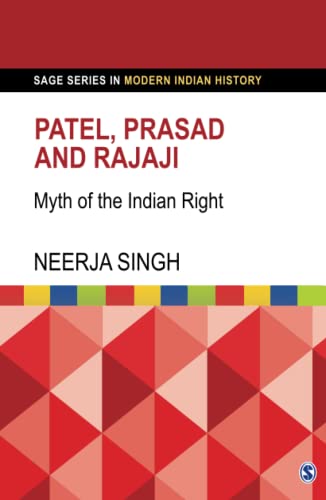
Patel, Prasad and Rajaji : Myth of the Indian Right / Neerja Singh.
Material type: TextSeries: SAGE series in modern Indian history ; XVIIPublisher: New Delhi, India : SAGE, 2015Description: xiv, 298 pages ; 23 cmContent type:
 - text
- unmediated
- volume
- 9789351502654 (hardback : alkaline paper)
- Patel, Vallabhbhai, 1875-1950 -- Political and social views
- Rajagopalachari, C. (Chakravarti), 1878-1972 -- Political and social views
- Prasad, Rajendra, 1884-1963 -- Political and social views
- Gandhi, Mahatma, 1869-1948 -- Influence
- Right and left (Political science) -- India -- History -- 20th century
- Indian National Congress -- History
- India -- Politics and government -- 1919-1947
- India -- Politics and government -- 1947-
- Democracy -- India -- History -- 20th century
- 320.5092/254 23
- DS481.P35 S56 2015
| Item type | Current library | Call number | Status | Date due | Barcode |
|---|---|---|---|---|---|
 Books
Books
|
Symbiosis School for Liberal Arts | 909/SIN (Browse shelf(Opens below)) | Available | SSLA-B-8058 |
Browsing Symbiosis School for Liberal Arts shelves Close shelf browser (Hides shelf browser)


"Delineating the differing ideological positions held by Sardar Vallabhbhai Patel, C. Rajagopalachari and Dr. Rajendra Prasad on the one hand and of their Leftist/Socialist detractors and opponents on the other, this book questions the validity of blanket branding based on Eurocentric categories without regard to the Indian context. It establishes that these three Gandhian leaders did not represent conservative or reactionary forces. They, in fact, practiced and promoted progressive ideas in their vision of socio-economic reconstruction of the country. Being anti-imperialist to the core, they stood for democratic and secular ideals promoting communal harmony effectively. This study attempts to relook at the categorization of 'Right' and 'Left' in our national politics and establishes the fact that 'history is not to be studied through the prism of politics.' It is as much a book for the scholars and researchers as it is for anyone interested in Indian politics"--Provided by publisher.
Includes bibliographical references (pages 280-289) and index.
Crisis of paradigm : historicity of the concept of "Right" -- Social vision of the Congress "Right" -- The Congress "Right" and the communal question -- Economic and political ideology of the Congress "Right" -- Strategic issues -- The Congress "Right" : the princes and the state peoples' movement.

There are no comments on this title.