
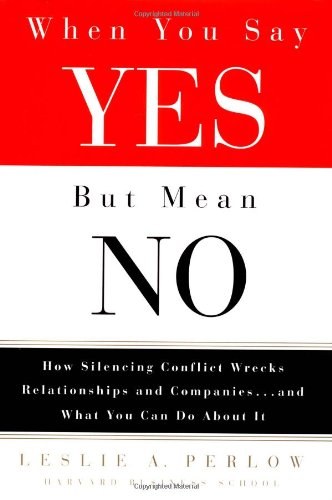
When you say yes but mean no: how silencing conflict wrecks relationships and companies, and what you can do about it
Material type: TextPublication details: Crown Business, New York, 2003.Description: ix, 254 pages; 22 cmISBN:
 - 9781400046003
- 658.405 PER
| Item type | Current library | Collection | Call number | Status | Date due | Barcode |
|---|---|---|---|---|---|---|
 Books
Books
|
Symbiosis Institute of Business Management - Hyderabad General | General Book | 658.405 PER (Browse shelf(Opens below)) | Available | SIBMH-B-2585 |
Browsing Symbiosis Institute of Business Management - Hyderabad shelves, Shelving location: General, Collection: General Book Close shelf browser (Hides shelf browser)


"We live in a culture -- especially at work -- that prefers harmony over discord, agreement over dissent, speed over deliberation. We often smile and nod to each other even though deep down we could not disagree more. Whether with colleagues, friends, or family members, the tendency to paper over differences rather than confront them is extremely common. We believe that the best thing to do to preserve our relationships and to ensure that our work gets done as expeditiously as possible is to silence conflict. Let's face it, most bosses don't encourage us to share our differences. Indeed, many people are taught that loyal employees accept corporate values, policies, and decisions -- never challenging or questioning them. If we want to hold on to our jobs and move up in our organizations, stifling conflict is the safest way to do it -- or so we believe. And it is not just with our bosses that we fear raising a dissenting opinion. We worry about what our peers and even our subordinates may think of us. We don't want to embarrass ourselves or create a bad impression. We don't want to lose others' respect or risk rejection. We often associate conflict with its negative form -- petty bickering, heated arguing, a bloody fight. But conflict can also be a source of creative energy; when handled constructively by both parties, differences can lead to a healthy and fruitful collaboration, creation, or construction of new knowledge or solutions. When we silence conflict, we avoid the possibility of negative conflict, but we also miss the potential for constructive conflict."

There are no comments on this title.